
OTT1236
Applications
Pathology software for steatosis (fat) grade quantification, rapid assessment of candidate donor livers in transplant settings, and biopsy index database searching.
Target Problems
Steatosis grade is a key factor in diagnosing and staging liver diseases, but manual assessment by pathologists is semiquantitative, discontinuous, and subject to variability. Variation in the assessment of steatosis, necroinflammation, and fibrosis can lead to errors in the diagnosis and staging of Non-Alcoholic Fatty Liver Disease (NAFLD), one of the most common liver diseases in the United States.
Solution
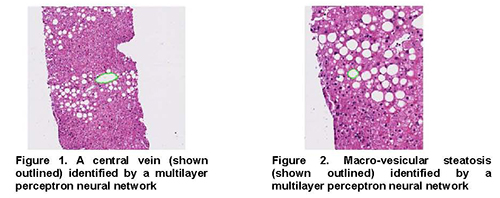
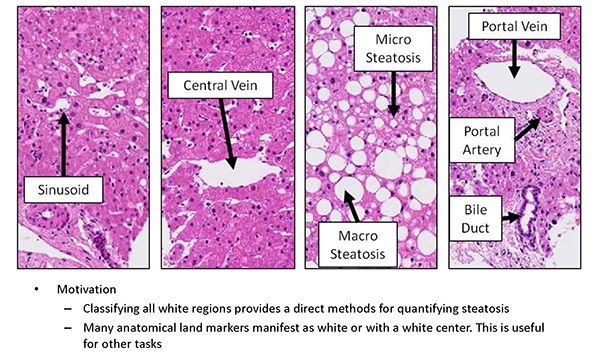
This technology uses supervised machine learning to automatically classify white regions in liver biopsy images and provide decision support for pathologists. By delivering rapid, automated, and highly accurate classification of biopsy features, the technology helps reduce variability in liver disease assessment and supports more consistent diagnostic decision-making.
Key Benefits
- Automatically classifies white regions in liver biopsy images
- Reduces variability associated with human assessment
- Provides faster biopsy evaluation
- Accurately classifies more than 90% of white regions
- Supports steatosis grade quantification
- Applicable to transplant donor liver assessment
- Enables biopsy index database searching
About this Technology
The invention is a supervised machine learning approach that automatically classifies white regions in liver biopsies into one of seven categories. The technology processes digitized biopsy images and identifies steatosis as well as important anatomical landmarks such as bile ducts, hepatic arteries, and portal veins. It currently achieves classification accuracy exceeding 90% and serves as a decision support tool for pathologists.
Stage of Development
The technology has been developed and demonstrated with classification accuracy of more than 90% for white regions identified in liver biopsy images. It is designed for use with digitized biopsy images generated through high-resolution scanning systems.
Partnering Opportunity
This invention is seeking partners. This invention is looking for partner apps with digital pathology companies, liver disease diagnostics developers, medical imaging software providers, transplant medicine organizations, and healthcare AI developers.
Intellectual Property
Registered Copyright. Protected and managed by the UWM Research Foundation.
Lead Inventor
Joseph Bockhorst