

OTT1461
Applications
Medical imaging systems, healthcare facilities, hospitals, data centers, CT scanners, MRI systems, and X-ray imaging equipment.
Target Problems
Conventional UPS solutions require tradeoffs between efficiency, reliability, and cost. Static uninterruptible power supply (UPS) systems often experience long switching times, poor performance, and limited voltage regulation, while online UPS systems suffer from lower efficiency due to continuous double-stage power conversion. These limitations can increase operating costs, installation complexity, and downtime for critical medical equipment.
Solution
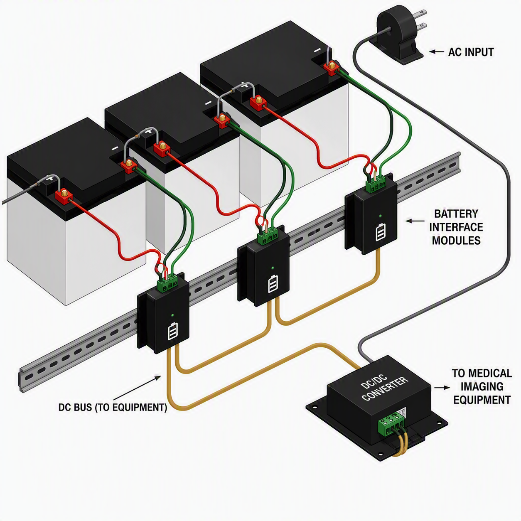
UWM researchers have developed a patented DC line-interactive UPS system for medical imaging equipment. The system combines backup power and load-leveling capabilities in a compact architecture by integrating a high-power-density battery with the equipment’s DC power infrastructure, providing a more efficient and reliable alternative to traditional UPS systems.
Key Benefits
- Reduces installation costs and time
- Improves equipment uptime and reliability
- Increases power efficiency
- Reduces electrical infrastructure requirements
About this Technology
The technology works by connecting a high-power-density battery directly to the medical imaging device’s DC bus. During normal operation, the battery helps level electrical loads and smooth power demand. If a utility power interruption occurs, the battery instantly supplies power to the DC bus without the conversion delays associated with conventional UPS systems. This direct integration improves energy efficiency, reduces the need for oversized electrical infrastructure, and enables continuous operation of CT, MRI, and X-ray equipment during power disruptions.
Stage of Development
Patented technology with demonstrated system architecture.
Partnering Opportunity
The technology is available for licensing and commercialization. The inventors are seeking strategic partners in medical devices, healthcare infrastructure, power electronics, imaging systems, and related industries.
Intellectual Property (IP)
Issued U.S. Patents: US2017/0085122A1, US2017/0271913A1, US10404098B2
Lead Inventors
Adel Nasiri, Ph.D., Distinguished Professor, Electrical Engineering, University of South Carolina
Ahmad Hamidi, Ph.D., Power Systems Manager, EnerSys