OTT1869
Applications
Lower-limb rehabilitation, bedridden patient mobility support, and clinical physical therapy assistance.
Target Problems
Bedridden patients often experience limited mobility and muscle deterioration due to prolonged inactivity, making rehabilitation difficult and resource intensive. Existing rehabilitation methods require significant therapist involvement or lack portability and adaptability for bedside use.
Solution
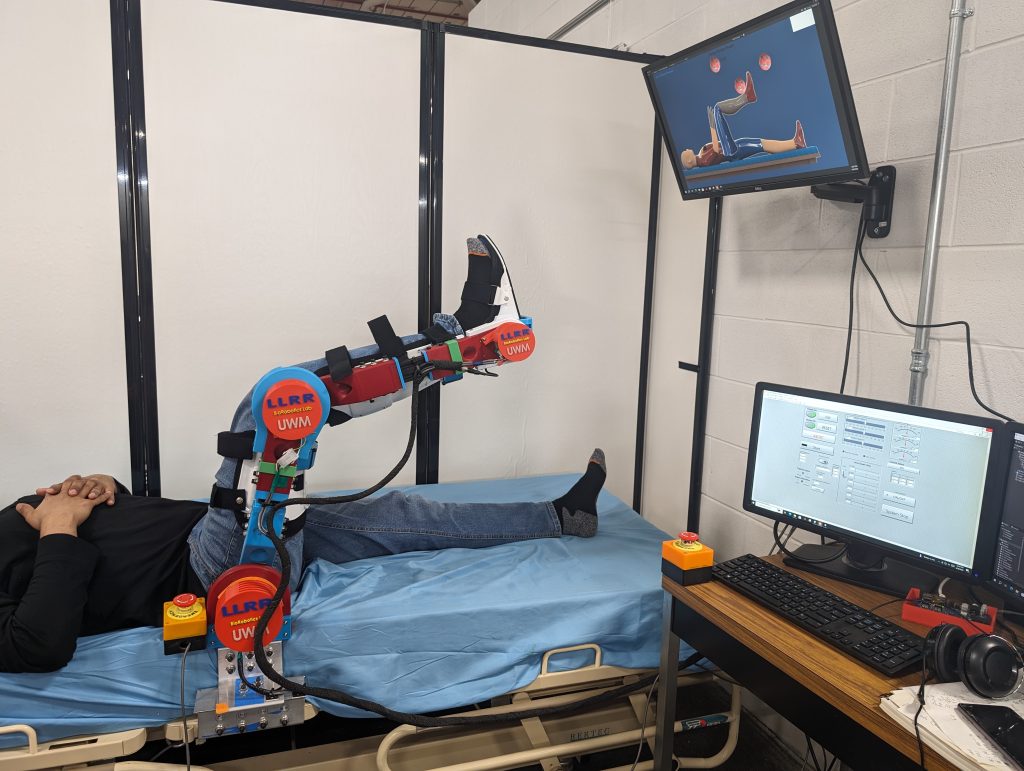
UWM researchers have developed a portable, bed-attachable smart exoskeleton for lower-limb rehabilitation, enabling assisted movement for patients directly in bed. It is designed to support therapy by facilitating controlled, repeatable leg motion, offering a practical solution that enhances rehabilitation accessibility and efficiency.
Key Benefits
Five Degrees of Freedom (5-DOF) per Leg: Enables a full range of controlled limb movements for comprehensive therapy.
Dual-Display Interface: Provides clinician- and patient-facing screens to support interactive engagement and therapy customization.
Data-Driven Therapy: Utilizes integrated sensors to capture joint angles, force, and motion with high precision, enabling remote monitoring, progress analytics, and outcomes-based treatment.
Reduced Therapist Time: Decreases therapist involvement by up to 70%, improving efficiency and scalability.
Lower Injury Risk: Minimizes the risk of patient injury by up to 90%, enhancing overall safety.
About this Technology
This technology consists of a smart, portable exoskeleton system that attaches directly to a bed and interfaces with a patient’s lower limbs to assist in rehabilitation exercises. It uses a mechanical structure aligned with the patient’s leg joints to guide controlled and repeatable motions, supporting therapeutic movement while the patient remains in a lying position. The system is designed to deliver consistent, assisted motion through integrated control functionality, enabling structured rehabilitation sessions without requiring the patient to be moved out of bed.
Stage of Development
A prototype of the system has been developed and is currently undergoing testing and safety validation, with efforts underway to support IRB protocol development and submission for future clinical evaluation.
Partnering Opportunity
The inventors have launched a startup, Roboheal Innovations, to develop and bring this technology to real-world use. They are looking for partners with medical device companies, rehabilitation centers, healthcare providers, and potential collaborators.
Intellectual Property (IP)
Patent pending. Protected and managed by the UWM Research Foundation.
Lead Inventors
Mohammad Habib Rahman, UWM Professor and Department Chair, Mechanical Engineering
Asif Al Zubayer Swapnil, UWM Graduate Student
Md Enamul Haque, UWM Graduate Student