

OTT1880/1894
Applications
Food processing safety monitoring, environmental contaminant detection, industrial wastewater analysis, and field-based diagnostics.
Target Problems
Conventional methods for detecting biological and chemical contaminants are often slow, requiring days to weeks or specialized laboratory infrastructure. Current lateral flow assays also struggle with low sensitivity and typically require pre-enrichment steps, limiting their ability to detect extremely low concentrations or distinguish between analytes.
Solution
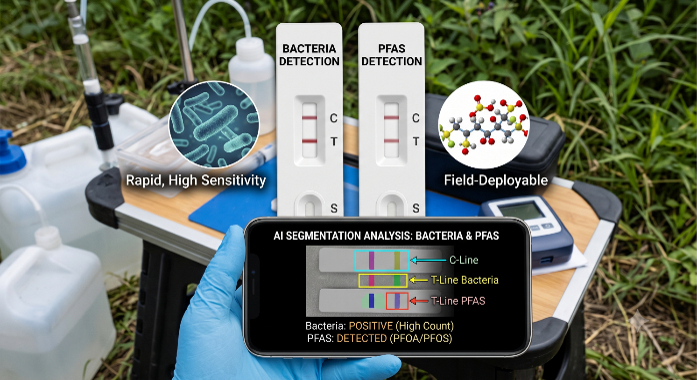
UWM researchers have developed a nanoparticle-based lateral flow assay system capable of rapidly detecting biological and chemical analytes with high sensitivity. By combining nanoparticle binding, magnetic enrichment, and visual detection, it enables fast, field-deployable identification of contaminants such as food pathogens and PFAS with minimal sample preparation, offering a more efficient and sensitive alternative to conventional methods.
Key Benefits
-
-
-
- Rapid detection without extensive laboratory processing
- High sensitivity for extremely low analyte concentrations
- Field-deployable and user-friendly format
- Capable of detecting both biological and chemical targets
- Supports analyte identification and differentiation (e.g., serotyping)
-
-
About this Technology
The system uses nanoparticles conjugated with binding agents (such as antibodies or aptamers) to capture target analytes in liquid samples. Magnetic nanoparticles can concentrate bound targets, while lateral flow assay devices generate visual or fluorescent signals when analytes are present. Detection is achieved through nanoparticle-mediated signal generation on a membrane-based test strip.
Stage of Development
The technology is currently at the provisional patent stage, with demonstrated assay systems, experimental validation, and example implementations described.
Partnering Opportunity
The inventors have also launched a startup, Invenio Pathogenix; to further develop and bring this technology to real-world use and they are seeking development partners with pharma companies, biotech firms, diagnostic developers, and environmental testing organizations.
Intellectual Property (IP)
Patent pending. Protected and managed by the UWM Research Foundation.
Lead Inventors
-
-
- Qingsu Cheng, UWM Assistant Professor, Biomedical Engineering
- Weizheng Wang, UWM Postdoctoral Fellow
-