Invenergy’s Support Moves UWM Energy Innovation Forward
A four-year partnership is helping university researchers move promising ideas closer to real-world use.
Turning a university discovery into a technology with real-world impact takes more than a promising idea. Researchers need resources to test concepts, build prototypes, understand potential markets and move discoveries closer to practical use.
For the past three years, Invenergy, North America’s largest privately held developer, owner and operator of power infrastructure, has helped UWM researchers take those important next steps through its support of the UWM Research Foundation Catalyst Grant Program. The company plans to continue that partnership for a fourth year, with another $50,000 commitment that will bring its total support of the program to $200,000.
“Invenergy supported the Catalyst Grant Program because of its unique ability to bridge the gap between early-stage research and real-world applications. As a company focused on building the future of energy, we recognize that many of the most transformative ideas require early investment to reach commercialization.”
— Chad Little, Director, Development, Invenergy
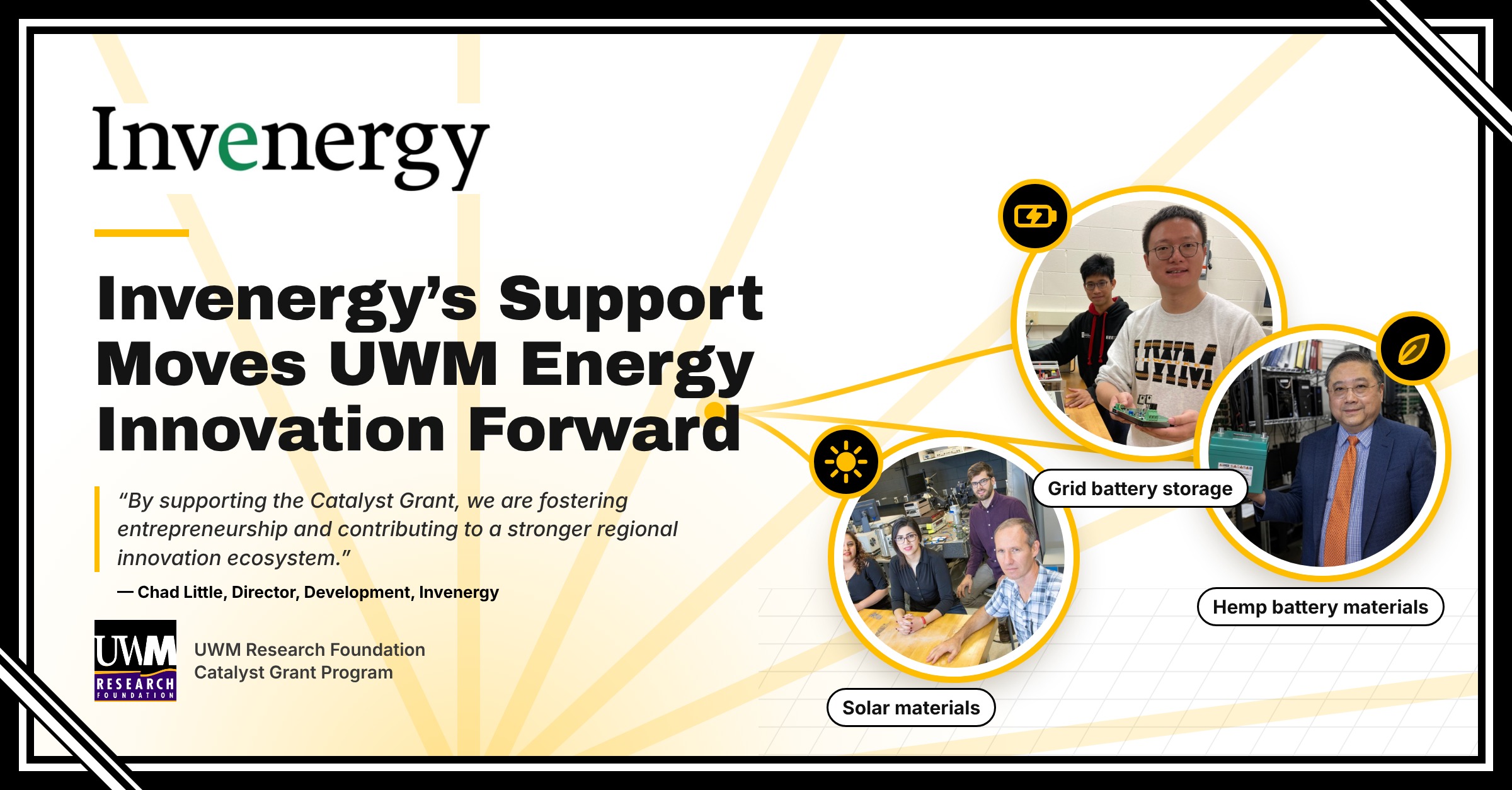
To date, Invenergy’s support has funded three UWM projects addressing new materials for solar and light-sensing technologies, battery energy storage and power conversion, and renewable domestic materials for batteries. Although each project approaches a different challenge, all share a common goal: translating promising university research into technologies that could contribute to the future of energy.
New Materials for Solar Energy and Light-Sensing Technologies
UWM researchers Dr. Nikolai Kouklin and Dr. Konstantin Sobolev are developing new zinc-based film materials that may offer a lower-cost, scalable option for solar-energy and light-sensing applications.
With Catalyst support, the team demonstrated that the material responds to ultraviolet and visible light and can be incorporated into relatively low-cost devices. The researchers also combined the material with a naturally derived dye to create a self-powered light detector, showing potential for future applications in solar-energy conversion, light sensing, and energy harvesting.
The project has already contributed to a peer-reviewed publication, a scientific conference presentation, and a patent application. The researchers continue to evaluate fabrication for scale-up, performance, reliability, and potential paths toward commercial application.
Improving the Technology Behind Large-Scale Battery Storage
Dr. Feng Guo, assistant professor of electrical engineering at UWM, is developing power-conversion technology intended to make medium-voltage battery storage systems more efficient, affordable, and scalable. These systems can help store electricity generated from sources such as solar and wind, then deliver that energy when the grid needs it.
Catalyst funding is enabling the research team to design and test its own power-electronics hardware rather than leaving the technology at the conceptual stage. The work could ultimately support more efficient battery charging and discharging, greater integration of renewable energy, and improved stability of modern electrical grids.
Exploring Hemp as a Domestic Source of Battery Materials
UWM researchers Dr. XiaoXiao Zhang and Dr. Deyang Qu are exploring whether industrial hemp could provide a renewable, domestically sourced material for batteries.
Their team is converting hemp into hard carbon that could potentially be used in battery anodes and comparing its performance with commercially available materials. The research is particularly focused on possible use in sodium-ion batteries, an emerging alternative that could help diversify domestic battery-material supply chains.
The team participated in the Milwaukee I-Corps program to speak directly with potential customers and industry stakeholders. Those conversations are helping the researchers better understand market needs and focus the technology on applications with the strongest commercial potential.
A Partnership That Goes Beyond Funding
Invenergy’s role in the Catalyst Grant Program extends beyond its financial contribution. A member of the company’s team also participates in the application-review process, bringing an energy-industry perspective as UWMRF evaluates the scientific strength and commercial potential of emerging technologies.
That engagement gives applicants the benefit of informed industry feedback and provides Invenergy with insight into the kinds of energy challenges university researchers are working to solve. It also strengthens the connection between early university research and the practical needs of the energy sector.
For Invenergy, the partnership reflects a broader commitment to energy innovation, workforce readiness and economic development, particularly in Wisconsin, where they just opened a regional office in Milwaukee.
“By supporting the Catalyst Grant, we are fostering entrepreneurship and contributing to a stronger regional innovation ecosystem.”
— Chad Little, Director, Development, Invenergy
Continuing the Momentum
Invenergy’s planned fourth year of support will fund another clean-energy-focused Catalyst award and continue the company’s involvement in identifying promising research with commercial potential.
UWMRF is deeply grateful to Invenergy for its continued partnership. Its support is helping UWM researchers move beyond initial discoveries, generate meaningful results, test commercial opportunities and pursue technologies that could address important challenges in energy generation, storage and sustainability.